-
Things I’ve loved in May
Is it me, or did May fly by? With me spending the first week of the month on holiday, coming straight home and into my new job (which, I’m delighted to report, is still wonderful nearly a month in) and a healthy dose of what my mother has taken to calling “gallivanting*”, it only seems like yesterday I was reflecting on the end of April. And yet here we are, in June. I’ve not had much time for writing (sorry), but I’m back to give a bit of a whistle stop tour of some of the things I’ve enjoyed most this month.
In writing this month’s roundup – the fourth I’ve done now – I went back and read over the previous months’ offerings. It’s been interesting to see how much has changed, both in my life in general and in the kinds of things I’ve been up to. And actually, with the end of April came the end of a pretty rotten year, for a lot of reasons I won’t bore you with. That doesn’t mean that everything is sunshine and roses now – a healthy dose of imposter syndrome from the new job, along with the biggest anxiety spike I’ve had to deal with in well over a year (probably closer to four) haven’t been much fun – but all in all, things seem to be a bit more even and a bit less dramatic. Which is nice.
*By which I mainly mean that I’ve been out of the house a lot, both because of the strange new feeling of “wanting to be in the office all the time” and having beaten my April record by seeing a grand total of seven shows this month.
Although it feels like I haven’t done much this month apart from The New Job (and lots of theatre), I’ve still managed to fit quite a lot in. Mostly this is thanks to my holiday, and so this month ‘s round-up is quite heavy on the Stratford-on-Avon content.
There’ll be a Things I watched in May (or maybe two) coming shortly, because there was far too much of it to squeeze in here. This is all the other fun stuff I’ve been up to, so strap in as I take you on a trip to the beautiful Midlands and…
RSC Guided Tour (Royal Shakespeare Theatre, Stratford-on-Avon)
It is a truth universally acknowledged** that when you’re in Stratford, you must do as many Shakespeare-related things as you can. And with my relatively recently revived love for the theatre, the RSC seemed to be the perfect place to start. I had a free morning the day after my trip to see Love’s Labour’s Lost and spending it finding out more about the building’s history seemed like a perfect choice.
There was something really wonderful about doing the tour the morning after I’d seen the production; it was a delight to step back into the world I’d enjoyed so much before (literally) stepping behind the curtain. That day was the first time for a while that tour groups were allowed onto the stage (timed that well, didn’t I?!) and it was such a thrill to step onto the hallowed astroturf, still littered with remnants of the previous night’s props. I also never thought I’d find myself reciting Shakespeare on the stage of the Royal Shakespeare Theatre, but there I was, giving it my best Caliban.*** I probably won’t be making my stage debut any time soon, though.
I still can’t quite believe the tour was only an hour, we packed so much in: from the original stage boards and gorgeous 1930s Art Deco box office still hidden in plain sight to the secret wardrobe change spots, the inside of both the main and Swan auditorium and the main stage, wardrobe and the audio description booth, I saw pretty much everything, and learned loads. It helped me fall even more in love with the world of theatre: not just the stuff on stage, but the whole process of making it happen.
There was a lot of emphasis throughout the tour on the importance the RSC places on making their productions accessible to as many people as possible, and it certainly came across. I loved getting a sneaky peek into the audio description booth; I’d never really thought about how it happens, I just took for granted that it did, and so it was a fascinating insight.
The tour finished on the bridge between the Swan and the main auditorium, giving us gorgeous views over the river and the town, as well as some mysterious former props on the building’s roof, and an extremely cool Lego rendering of the great man himself. And if you’ve ever wanted to be roasted by a piece of furniture, having a quick sit down in the Insult Chair is an absolute must. (I’ll leave what it said to me to your imagination).
**Yes, I know this is an Austen quote. I’m on a deadline and I couldn’t think of a Shakespeare one that would fit. Stop whining.
***The best speech, from the best play, I’ll fight anyone who doesn’t agree but not before I’ve made them watch this – if Sir Kenny B doesn’t give you goosebumps the Elgar will)
Our guide was brilliant – he works front-of-house as well as doing the tours, so he had plenty of stories to tell along the way, and clearly loved the place. They say no two tours are the same, so I’m definitely planning on doing another one the next time I find myself in Warwickshire.
The tours run most days, and you can find out more and book tickets online through the RSC website.
Unravel (Barbican, London)
I read somewhere that the mark of a good reviewer is being able to reflect and detach their opinions about whatever they’re reviewing from their emotions and mood at the time. In that case, I’m not a good reviewer – and I’m fine with that. For me, the ability of a thing (be it a place, show, exhibition, book…whatever it is) to affect my mood for better or worse is an integral part of whether I enjoy it or not, and I need to acknowledge my existing mood before I can judge how it’s done.
If I’m honest, I was in a foul mood the day I went to see Unravel. I’d had a very late night the day before, it was hot and humid in London, I’d spent twice as long as I should have actually getting to the Barbican thanks to some nonexistent buses**** and by the time I made it, I’d missed my booked time slot for the exhibition. And I’m really, truly not a fan of the City of London; as The Kids would say, the vibes are off, and I’d prefer not to visit if I can help it. All of that meant that I was a tiny bit stressed and grumpy by the time I set foot in the gallery.
What I really hoped would happen at this point was a Hayward Gallery-esque step into another, more peaceful world (sidenote: I’m super interested to see if I have the same response to the Hayward’s upcoming exhibition as I did to When Forms Come Alive, and finding out if it was the space or the art that I fell in love with). Fibre arts in general (knitting in particular) are my bag, and I’d heard really good things about Unravel from folk I know who’d visited before me, so my expectations were high.
Sadly, I went away a little bit disappointed.
It was good, sure – the individual works were beautiful, meaningful, intricately crafted and many of them had brilliant stories to tell. Sadly – and without shelling out forty quid the full exhibition catalogue – I can’t find any of the information online anywhere. (Another place where the Barbican could learn a lesson from the Hayward, where I can see everything from past exhibitions on the Bloomberg app…). I think the exhibition as a whole, by including a number of subversive or hard-hitting works, thought it was being edgier than it was.
I’m not one to judge anyone’s parenting choices, but it made me pretty uncomfortable viewing some of the more explicit works (of which there were quite a few) with infant-school aged kids around.
Despite grouping the works into distinct themes around the gallery space, the exhibition as an entity felt incomplete. Partly, this was because it was, indeed, incomplete. A number of artists had withdrawn their work from the exhibition in an act of solidarity with Palestine, and the space their works would have occupied was held, sometimes alongside an additional statement from the artist themselves. Other artists had requested that statements were displayed alongside their work.
Actually, these acts, and the reminder that art is by its nature political, were the most thought-provoking and powerful part of the exhibition.
****although this did lead to me getting to finally take a trip on the Elizabeth Line. 9/10, a very good line, excellent station design. But I’d rather my inaugural trip wasn’t on this particular occasion when I was too frazzled to truly appreciate it.
Unravel ran from 13 Feb – 26 May at the Barbican, London, and will be in Amsterdam in September 2024.
Oh…and a bonus Thing I loved in April But Forgot: Birdsong Walk (London Wetland Centre)
Last month’s Things I’ve loved was a bumper one and, despite making a list (and checking it twice, it’s not just for Santa) I still managed to forget one of my favourite things from April.
As someone who writes mostly about city-based things that happen indoors, you’d be forgiven for thinking I’m not much of a nature lover. You’d be forgiven for thinking that, but you’d still be wrong. I love being outdoors, in the wild, especially by water. The London Wetland Centre is one of my favourite sanctuaries for this, getting to hang around with some cool birds and forgetting I’m in the city.
Having been on one of their bat walks last year, and had a terrific time, I booked onto one of their early-morning birdsong walks. There isn’t much that gets me out of the house at 7:30am on a day off, but spending an hour before the centre opens, listening to the tail end of the dawn chorus and learning how to identify some of the calls is one of them. And it was glorious. As well as the usual robins, blackbirds and ubiquitous parakeets, we heard (and in some instances saw) a host of other birds including chiffchaffs, blackcaps, reed warblers, Cetti’s warblers, sand martins and reed buntings. It was bird nerd heaven.
It’s such a friendly thing to do, too – the only people who’ll turn up in Barnes at 8:30 on a Wednesday morning are people who truly love doing this kind of thing, and so chatting with them, and the guides, as we walked around, was a delight.
There aren’t any other birdsong walks scheduled at the moment, but if and when they offer more dates, I’d absolutely recommend it.
Songs on repeat
I’ll be honest with you: at this point, my ears are really only interested in the Eras Tour (Ear-as tour? Is that something****?). There’s been a lot of Taylor, obviously. But I’ve also gone deep into a Paramore re-listen. I’ve loved them for years, so to get to see two of my all-time favourite acts in one show is going to be a bit of a dream come true.
I’ve been trying really hard not to get too annoyed at all the “who is Paramore? The band supporting Taylor Swift on the Eras Tour in Europe” articles churned out by the usual suspects gagging for clicks – it’s not the Baby Swifties’ fault they haven’t been given the chance to hear Brand New Eyes before. So, instead, I’ve used it as an opportunity to remind myself of how marvellous their back catalogue is, all in the name of making sure I’m adequately prepared for the show.
Plus, it turns out they’re the perfect mood for a morning commute; my only challenge is not singing along (harder than you’d think when you’re blasting crushcrushcrush and Still Into You into your ears at 7:30am).
*no, no it isn’t. And I can only apologise
One last thing…
Before you go, I’ve got a little favour to ask. If you’ve enjoyed this post, or any of my others, I’d really love it if you’d subscribe. You’ll get my posts straight into my inbox, which means you won’t miss anything (for some reason the algorithms often bury the ones I’m proudest of) – and every now and then I’ll write something extra just for subscribers. It won’t cost you anything, I promise not to spam you, and best of all, you’ll earn my undying love and gratitude
So, that was May. And it’s been lovely. Of course, there’s been lots of other things I loved that didn’t warrant their own segment: brunches, cat cafés, walks, reading books in the sunshine (and in the rain), spending time with friends and eating what I can only describe as shedloads of ice cream.
So far all I know about June is that it’s going to feature yet more theatre. I hope there’ll also be some museum visits in there; I just haven’t had the time or the energy, but I’m starting to miss them already. Although we’re approaching peak Tourist Season, and I hate crowds, so we’ll see how that turns out.
-
Things I watched in April
Not one to do things by half, this month I’ve gone from not seeing anything for over six years, to seeing six shows in the space of just over a fortnight. Completely normal behaviour, I think you’ll agree.
Because I’m not a theatre critic (I prefer sitting back and enjoying the show to making notes all the way through), these don’t get their own posts, but there were FAR too many of them to include in my usual monthly roundup. So without further ado (because I am fully aware we’re two thirds of the way through May already), may I present…things I watched in April.
2:22, a ghost story (New Victoria Theatre)
I’ve wanted to see this for a really long time – and were it not for their insistence in casting random “celebs” (rather than actual, proper, trained actors who’ve worked hard for years – can you tell this is a pet peeve of mine?) in the leading roles, presumably for clout, it probably would have been the show to break my theatre-less streak much earlier than it did. Alas, every time I thought I might go they announced a new cast, with each iteration sillier than the last.
The touring version (thankfully, with a far more sensible cast, all of whom have actually done some acting before) rocked up at my local-ish theatre, and so it seemed like a good opportunity to satisfy my curiosity.
Part of the appeal is knowing as little as possible, so there’s not much I can say here except that it’s quiet-quiet-bang jumpscare heavy, and I, of course, jumped out of my skin every time, even when I knew it was coming. I’d made a conscious decision to sit back and enjoy (I’d say relax but…no) without trying to figure out the plot twist at the end, and if you’re planning to see it I’d recommend doing the same: it’s much more fun that way.
It’s popcorn theatre, and there’s absolutely nothing wrong with that. But there’s no doubt it’s better when actual actors are doing the acting. And they did, in fact, act very well. It’s not high art, but it’s not pretending to be. And I enjoyed it for what it was. Though I’m not sure it was worth the very expensive box seats I had no choice but to buy if I wanted to be comfortable.
Would I see it again? Perhaps. Will I be going to see it again when it returns to the West End? With Stacey Dooley joining the cast: absolutely not.
Nye (National Theatre)
This was the play that set me off on my original theatre-seating rant back in February. As you can probably work out from its inclusion here, I managed to find a way to see it comfortably in the end. It took a lot more time and effort than I’d have liked, but we got there eventually – and to the National Theatre’s credit, everything went smoothly on the night, leaving me to relax and enjoy the show in almost unheard-of (for me in a theatre, at least) comfort.
Anyone who I talked to in the week after I saw this has heard more than they ever wished to hear about what I thought of Nye, but I make no apologies for it because, frankly, it’s the best show I’ve ever seen.
Firstly, the obvious: Michael Sheen is a mesmerising presence onstage; even when the focus of the scene was elsewhere (which, quite rightly, wasn’t often) I couldn’t take my eyes off him. If there was ever a man born to play Aneurin Bevan, it’s Sheen. Bringing the energy and zeal of those impassioned speeches in defence of the NHS with a huge dollop of pathos, he drew me effortlessly into the fantastical retelling of his story.
There was something beautiful about the staging, too: simple in design, but effective in execution, it complemented the almost fairytale nature of the storytelling as it took us from schoolroom to mine, hospital ward to Parliament.
The final scene is one of the most beautifully, devastatingly moving things I’ve seen; the tears were streaming by the time the lights went up. It’s truly a fitting tribute to a man who changed the fabric of this country for the better.
It’s finished its stage run now, but you can still catch it showing in cinemas around the country. And in case you hadn’t worked it out by now, I really think that you should.
Opening Night (Gielgud Theatre)
If you’re wondering why you’ve vaguely heard of it, yup, it’s the Sheridan Smith one that’s closing two months early because the reviews were so dreadful.
This was a spontaneous late addition to the list, thanks to a friend with free tickets and a healthy dose of “what’s the worst that could happen?” – and as such, I approached it with a fair amount of trepidation. After all, I didn’t have the chance to check out the seat situation (…seatuation*?), or even pick my seats**. But it was a freebie, so I thought it was worth taking a risk. And thankfully it paid off – the seats at the Gielgud are surprisingly comfy (and a 10/10 for legroom). So far, so good.
*I know. I’m so sorry
**A note here, that my friend did offer – and indeed tried – to find out. Which doesn’t feel like a big deal, but it meant the world to me (see how easy it is to help your fat pals out?) Because it was so last-minute, that didn’t work out and I had to decide whether or not to take the risk. A decision that was made far easier by virtue of the fact that they were already firmly on my (sadly small) list of “Safe People To Go To The Theatre With”, so I knew I’d be OK even if the seats…weren’t. But I’ll come back to Safe People.
Then the production started.
The first act was better than the second; there were some careless and frankly silly mistakes peppered throughout which gave the whole thing a feeling of being hastily cobbled together. I won’t go on about them too much, but they were enough to be distracting through quite a big chunk of the performance. If there’d been less music (more on that in a minute) and about fifteen more minutes of dialogue I would have been far more invested in the whole thing. But honestly it….wasn’t that bad? It feels like I’m damning it with faint praise, and I suppose I am. And if I hadn’t read the reviews beforehand, which placed my expectations about as low as it’s possible to go, I might well have felt differently. But it was fine.
The acting was good: quite honestly I think I’d pay to see Sheridan Smith read the phone book, and it was a joy to watch her having a whale of a time onstage despite the dreadful press the show had had so much of by that stage. The supporting cast were also great – once I’d managed to place John Marquez (PC Penhale from Doc Martin, to save you a Google) and could actually get on with watching the damn thing.
Onto the music. Dear god, the music. I’ve found it endlessly funny to watch Rufus Wainwright (the perpetrator of the aural hate crimes) whining about all the reasons the show flopped (including, among other things, Brexit, somehow…) when it’s almost certainly at least 70% due to the forgettable dirge emanating from his general vicinity. Not one memorable tune could be found anywhere, the range did absolutely nothing to highlight (or even slightly challenge) Smith’s vocal capabilities, and it frankly all sounded like tarted-up lift music. It certainly didn’t feel like a “proper” musical in any sense of the word.
The highlight of my evening turned out to have nothing whatsoever to do with the play, and everything to do with my pal taking me on a detour in the tube station to show me the STUNNING world clock tucked away at Piccadilly Circus: smack-bang in the centre of my nerdy wheelhouse, and it moved me far more than Opening Night did (rumours I welled up while I was looking at it may or may not be true, and I will not be commenting further).
6/10 for the show, 1000/10 for having friends like that.
Player Kings (Noel Coward Theatre)
I have Big Feelings about my evening at the Noel Coward, for a variety of reasons which (I can feel another long read brewing) I might do a deeper dive into another time. But I’ll start by saying that, if it had been my only recent theatre trip, the experience would have stopped me wanting to go again.
Before I booked tickets, I had a frankly very silly conversation with the box office in which I was told that they don’t have the dimensions of the seats (and, apparently, nobody had access to a tape measure) but that, based on my size, I’d “probably be fine”. I don’t know quite what I was thinking when I decided that was more than enough reassurance for me to drop fifty quid on a ticket, but drop it I did.
Reader, the seat was one of the most horrifically uncomfortable I’ve ever had the misfortune of sitting in. And I’ve been in the gods in the Palace Theatre. Mercifully I’d booked an aisle seat, so at least one of my legs had somewhere to go – and for a brief, beautiful moment I thought I might have got lucky and scored an empty seat next to me.
But alas, my rowmates shuffled in about 30 seconds before curtain up. Cue me trying to contort myself to stay out of their space. And I didn’t need to be able to hear what they were saying to know they weren’t thrilled at having to sit next to me. You don’t need the words to be able to recognise the looks, and smirks, and sniggers.
There’s quite a lot of comedy in (both parts of) Henry IV, considering it isn’t technically a comedy. Which would have been nice, if 90% of the jokes weren’t at Falstaff’s expense, the main punchline being that he’s fat (and therefore greedy, lazy, etc, insert more boring tropes here, etc etc). Some things never change. Yawn.
I get it, it’s Shakespeare so it’s more complicated than saying “don’t make lazy fat jokes”. It’s not as simple as “we won’t put this play on again” – and I don’t think I’m suggesting that’s the answer. All I know is that the sheer volume of the laughter at each joke, and each glimpse of Ian McKellen in his Falstaff fat suit, hit me like a punch to the face. Every. Single. Time. That familiar, drenching shame coursing hot through my body. Feeling like the kid in the playground, with everyone around them pointing and laughing and taunting.
These situations are a painful reminder that, despite the work I’ve put into accepting (sometimes even liking) my body, the way I look, most of the rest of the world doesn’t feel the same. My seatmates certainly didn’t. And apparently it doesn’t take a lot to bring my confidence crashing to the ground.
It’s been a long time since I’ve been anywhere I’ve felt that unwelcome and, honestly, a little unsafe. It was such a painful experience (both physically and emotionally) that I nearly left at the interval. Somehow, I managed to persuade myself to stay. I think I’m glad I did.
Someone far cleverer and more knowledgeable than me described the first part as cinematic, and the second as being more typically “theatrical”. And that’s exactly what it was. It really felt as though the two parts had different directors (they didn’t). And – excepting the Massive-Attack-soundtracked battle scene at the end, which felt jarringly heavy-handed – I definitely enjoyed the drama of the first part more than the second. It was beautifully crafted, beautifully acted (not just from McKellen but across the board, with a captivating Toheeb Jimoh performance deserving particular praise) and – despite my discomfort – kept me pretty well engaged throughout. Given it ran to almost four hours in total, that was quite impressive.
I just wish it hadn’t felt like such a hostile environment for me to be in.
Love’s Labour’s Lost (Royal Shakespeare Theatre)
I snuck this in right at the end of April, during my holiday in Stratford. It felt rude not to pay my first visit to the RSC when, for once, it had some actual Shakespeare on while I was there.
Other than reading a very brief synopsis, I knew nothing about the play beforehand, so the whole thing was a bit of a surprise. It’s standard Shakespearean comedy fare, with crossed wires aplenty. The updated, modern-day Pacific island setting fit beautifully, with an underpinning of respectful and reverential appreciation of Hawai’i’s culture highlighted by the brilliant onstage musicians.
The set design was somehow both simple and brilliantly elaborate, with the resort of Navarre almost becoming a character in it’s own right at points, and always beautiful against the soft pastel palette of the costumes.
I haven’t watched Bridgerton, but I can say with absolute certainty that Luke Thompson’s Berowne would have been a treat for anyone who has. If the sight of him in grey sweatpants towards the end of Act One felt like a subtle wink in the direction of ‘Ton fans, stripping him down to his Calvins in Act Two was a twenty-one gun salute.
The cast across the board was magnificent, without exception. The standout performances, though, came from Nathan Foad’s gloriously frivolous Costard, and Tony Gardner (perhaps best known to those of us of a certain vintage as the dad from My Parents are Aliens) absolutely note-perfect as the laughably pompous Holofernes. The latter still managed to inject a healthy dose of humanity into the performance (I almost shed a tear on his behalf in one scene towards the end) despite, in my opinion, not getting anywhere near enough stage time. (Who wrote this play, anyway?)
I’d happily have gone back night after night but for the fact, well, the RSC isn’t cheap. Nye might be the best show I’ve ever seen, but this is a very, VERY close second – and it’s far and away the best Shakespeare production I’ve seen. I wish it was on for longer; I wish I’d had a chance to see it again.
Has it sparked a mild obsession with both Shakespeare in general, and the RSC in particular? You might very well think that, but I couldn’t possibly comment.
So, that’s that for April.
Before you go, I’ve got a little favour to ask. If you enjoy reading the blog, I’d really love it if you’d subscribe. You’ll get my posts straight into my inbox, which means you won’t miss anything (for some reason the algorithms often bury the ones I’m proudest of) – and every now and then I’ll write something extra just for subscribers. It won’t cost you anything, I promise not to spam you, and best of all, you’ll earn my undying love and gratitude.
Thank you, and I’ll see you at the end of May ♥
-
I read a book: Will I Ever Have Sex Again?
Full disclosure at the top: I was lucky enough to be sent a proof of this book to read ahead of its publication later in May. Nobody has asked or told me what to write (believe me – nobody would have told me to write any of what’s coming), and these are my honest thoughts. I’ve also ordered my own (physical) copy of the book, with my own money.
If you want a taster, The Guardian published an edited extract last weekend, which you can read here (content warning: the extract contains references to sexual assault).
I don’t know if this really counts as a book review post. In a way it is, because I’m telling you what I think of the book. But it’s also a response, I suppose: a collection of thoughts I had when I was reading it, and have had since.
Truly, I’d challenge anyone to read this book and not have a LOT of thoughts after reading it. And I’ve read it in its entirety three times now (and some bits many, many more times than that.
So, if you’re not up for reading my feelings and opinions about sex and sexuality (especially if you know me and it would feel weird), this is your last chance to stop reading.
First, the premise: Sofie Hagen – comedian, podcaster, writer and activist – hasn’t had sex in over 3,000 days. In an attempt to explore why that is, she put together a survey to gain some outside perspective and was somewhat overwhelmed by the responses that came in within the first day.
The book is part factual exploration of some of the reasons people (who want to) aren’t having sex (including conversations with a wide range of experts, therapists, sex workers…the list is endless), and partly personal reflection – both from her own life and from some of the survey participants.
I didn’t do it on purpose, but that’s the form this post seems to have taken, too. Rather than my usual synopsis > verdict kind of review, I’ve talked a bit about some of the main aspects WIEHSA (as I’ll refer to it from now on) covers, and a few of my own thoughts, reflections and experiences along the way. It just seemed to fit better.
I’m offering my reflections in the spirit of the book: I hope that by me being a little bit messy, a little bit raw, it might make someone else feel a bit less alone. I also hope that it might point you towards the book that helped me feel less alone, and has gently scooped me up and carried me a little bit further down the path to actually knowing what’s happening inside my brain.
So really, this is your final chance to stop reading if you’d rather not know what I have to say on the subject.
This book is funny. Like, really funny. I’d only got as far as the dedication before I was snort-laughing, and there were plenty more laugh-out-loud moments as it went on. Importantly, what it doesn’t do is make light of the topic, of anybody’s experiences, or how much of an impact sex (or the lack of it) has on people’s lives.
The mix of information, expert insight and personal stories gives a comforting feeling of give-and-take: the anecdotes offered up in each segment meant that in having my own insights, realisations and emotional responses I didn’t feel exposed, because Sofie had gone there first.
It’s also frank. Not in the way a lot of writers are, where it actually means “I’m going to try and make myself feel big and clever by shocking you into feeling like a repressed prude when I, in fact, am the problem here”. It’s frank in an actually honest – refreshingly so – way. The way you’d talk with your friends, when there’s no worry about being judged or laughed at or made to feel wrong.
And that’s what the book feels like. A chat with a friend. But not in that jarring, “I’m trying to force a parasocial relationship which I will then constantly complain about on social media” way. A chat with a nice, safe, trustworthy and reassuring friend who genuinely wants you to learn as much as they do themselves. It’s very much like the book-version of Hagen’s podcasts, except she is both guest and interviewer. In the context of the book, and the subject matter, this is really important. In different, less careful, hands this book would have been a very different beast.
I remember filling out that survey. I don’t remember anything about the questions, or about my answers. What I do remember is thinking “I bet my responses are going to skew these results, because whoo boy are my experiences not going to match most people’s”.
Dear reader, I could not have been more wrong.
Early on in the book, Sofie writes “In [the respondents’] stories, I learned more about myself. I felt a sense of community, of support, of being part of something bigger than myself”. And that’s exactly the feeling I had when reading it.
Skimming through the chapter list before I started reading, I could tell that some of the chapters would likely have more impact on me than others. And honestly, there were some I’d expected not to really get anything out of.
Gender was one of those. As a cis woman, who is very certain of that fact and always has been, I didn’t bank on this chapter having anything much to say to me. I’ve always felt comfortable with my gender, and how I express it: mostly I’m a jeans-and-jumper girl, I don’t wear much, if any, makeup in my everyday life, and neither of those things make me feel any less a woman. It’s made me realise, though, that my default response any time I want (or am expected) to seem more sexually attractive, I really lean into stereotypical “femininity”: red lips, more mascara, heels, skirts, jewellery. And there’s nothing wrong with any of that, at all. I did find it interesting, though – none of the women who raised me really went in for much of that stuff, so it’s made me question where it’s come from. I haven’t come up with many answers yet, but I’m still chewing it over.
The gender chapter also looks at intimacy – and that’s the first time that the book made me stop in my tracks (by which I mean, made me cry). So many people use the words sex and intimacy interchangeably now (I’m looking at you, Married At First Sight) but there’s a world of difference. You can have sex without intimacy, and intimacy without sex. Which seems like it might be obvious, but it…somehow wasn’t?
Throughout the book there’s a thread that runs throughout, about honesty, truth, trust and how vital they are – how one of the keys is being able to be authentically and completely yourself, in order to have intimacy and/or good sex. I’m going to come back to this in a little while, but – having had a lightbulb moment of my own along similar lines quite recently – it hit me like a baseball bat to the face.
In contrast to gender, I was pretty sure before I started that the bodies chapter was going to give me some Big Feelings to deal with.
Sofie starts by talking about her relationship with her own body and how it’s evolved over a number of years. A lot of it resonated with me; Sofie’s book Happy Fat was instrumental in my own journey towards fat liberation, and accepting my own body. I’ve done so much work on my own relationship with my body, especially in the last few years, and, honestly, I thought the work was done. I’m relatively confident, most of the time – a far cry from twentysomething me, wearing cardigans in thirty-degree heat lest someone should see my arms.
Again, dear reader, I could not have been more wrong.
Most, if not all, fat folk have experienced the cruel flirt-pranks that Sofie mentions at least once. I certainly have. And, honestly, thinking back on it stings almost as much as it did at the time – and I am definitely still an “emotional flincher”. Add some ADHD rejection-sensitivity into the mix as well, and honestly it’s a wonder I go outside at all.
And then I read on a bit further, and I finally hit the line that hasn’t left me ever since:
“Learning to love my body is a tricky journey but it is easy, compared to learning to trust that other people can love it”
Oh.
Oh fuck.
I couldn’t stop rereading it. I literally sat on a bench on the south bank, sobbing and reading the same few paragraphs over and over again, and I couldn’t stop.(In hindsight, that might not have been the best idea while I was waiting to meet a friend, but I’d lost control of my common sense by this point)
It was such a perfect description of how I felt – how I feel – without me ever having thought about it, or how I might articulate it. Which is why it felt like a gut punch. I’ve done so much work on my own relationship with my body, to the point where I can say that I am happy with it. I love it, most of the time. But it had never occurred to me that there’s a difference between loving my own body and believing anyone else could love it. Could love me because of, not despite, well…me.
I am fat. The world spends a whole lot of time, energy, money on telling me I’m wrong, ugly, unlovable, disgusting. I thought I’d done a pretty good job of detaching those messages from my brain. But they run deep. Really fucking deep. I’ve had other situations where I’ve realised how deep, and how vulnerable and awful I can still feel (and, once again, more on that in another post soon).
I’d never thought about it, not really. Not in this context. I guess if I’d thought about it at all, I assumed it just wouldn’t ever apply to me. That I’d always be someone that, if anyone loved me at all, found me desirable at all, would do so despite the way I look. Because up until very recently, that had been my experience, without exception.
Before this year, I’d never experienced the positive things that Sofie and various of the experts talk about throughout the book: not just in terms of my body, but feeling seen, understood, cared about? Those micro-moments of trust, safety, not feeling pressured.That isn’t to say that I’ve had nothing but bad experiences – thankfully I haven’t had any that have been truly bad, and I’ve never felt unsafe – rather that it’s all been…neutral. And it’s hard to feel cared about, or understood, or desired, when the overwhelming feeling is simply…meh.
Even now, there has only been one person who has made me feel all of those positive things. I know I’m lucky that I’ve experienced that feeling at all; I know not everyone has. I still find it hard to believe that I deserve it. And harder still to believe that I’ll ever experience it again.
Statistically speaking, it’s unlikely that I’ve already met (and already lost) the one and only person out of billions on this planet who could and would make me feel sexy, desirable, desired, understood, valued. Who very obviously and clearly paid attention to all of those little micro nonverbal signals – even ones I didn’t realise I was giving out. Who I could fully let my guard down around, be myself around, who I didn’t feel self-conscious with.
But when I measure the statistics against my experience of life so far, experience shouts far louder, and has a far more convincing argument. It was late February when I started reading WIEHSA, and it’s now early May. I’ve spent time pretty much every day since then trying to unpick and unravel everything that’s going on here, and I’m nowhere near done. In the same way it’s taken years to shape my thoughts and beliefs around my body, I think it’s going to take quite some time to rethink my approach.
There’s been a lot for me to unpack, and I know there’s more to come, but I feel so much less alone than I would have without WIEHSA. Honestly, without this book I wouldn’t have even had the courage to begin, and I’d have just carried on feeling broken and wrong and weird and….other. it’s given me a sense of ownership of my own experiences and feelings and identity that I didn’t have before. Which almost feels silly to say, but there we go.
I feel confident saying that, whoever you are and whatever your relationship with sex, and your own sexuality, it will make you think A LOT. I think if I’d known that before I started reading, I might have had second thoughts. But I’m so, so, very unbelievably glad that I did read it. It’s made me cry more times than I expected, and almost more times than I can count. So far, as well as in my bedroom, on the train, at my desk and on my sofa, I’ve cried at this book in a really rather busy Wagamama; a riverside bench on the South Bank in rush hour; an ice cream shop and (as of this morning), a wall outside the Royal Shakespeare Theatre.
But all of that: all of the tears and realisations, and all the thinking back, has happened in a framework of total safety. Sofie has done something remarkable with this book – it’s informative without being preachy or patronising, deeply personal without being unrelatable (the dating app panic is real), and just so utterly gorgeous that I wish I could buy copies for literally every person I know, so they could benefit from it too.
I am not a millionaire, so I can’t do that; what I can do is really encourage you to read it in whatever way you can: buy the book/ebook, request it from your library, listen to the audiobook. Just, please, read it. Even if you don’t think you need to. Maybe even especially if you don’t think you need to?
Will I Ever Have Sex Again? Comes out on 23 May 2024. You can (pre-) order it here
Before you go, I’ve got a little favour to ask. If you enjoy reading the blog, I’d really love it if you’d subscribe. You’ll get my posts straight into my inbox, which means you won’t miss anything (for some reason the algorithms often bury the ones I’m proudest of) – and every now and then I’ll write something extra just for subscribers. It won’t cost you anything, I promise not to spam you, and best of all, you’ll earn my undying love and gratitude.
Thank you ♥
-
Things I loved in April
Spring always seems to usher in change for me, and this year has been no different. I’ve spent the last couple of weeks saying a lot of goodbyes as I left my old job – and a significant chapter of my life – behind. So here we are. April has been and almost gone, and what a month it’s been.
In stark contrast to both February and March, April has felt softer, easier. It hasn’t been plain sailing, but overall it seems as though the clouds have parted. The ending of my time at my old job, amongst other things, has given me cause to stop and reflect on the last few years, and the last few months in particular. I don’t think I’m exaggerating if I say it feels like there’s been a pretty seismic change over the last six months or so; I’m barely recognisable compared to the Steph that existed last autumn. If you’d told me back then that I’d be heading into the West End of London, willingly, in rush hour, I’d never have believed you. I never thought I’d be able to do that again. But I did. And it was good.
I’m going to resist the temptation to over-sentimentalise here; suffice it to say that it isn’t just me that’s noticed the difference. I’ve had quite a few people say things to me along the lines of “it’s so nice to have the old Steph back again” – and how true it is. There are a lot of reasons, but a big part of it is being able to surround myself with some truly brilliant friends – old and new, nearby and far away. Friends that bring out the best in me. Friends I feel safe being vulnerable with, and that I can be weird with. Friends that raise the bar for everyone else in my life. And I feel incredibly lucky.
At the time of posting this, I’m away on holiday (hence me posting this a day late…oops), and I’m not sure I’ve ever needed a break more than I needed this one. It’s tempting to beg whoever’s in charge for a quieter month in May, but given the amount of stuff I’ve already got in the diary, along with being about to start a very exciting new job, that simply isn’t going to happen. So I’m just hoping the only drama to be found in the coming month is on the stage.
I had to laugh as I reread March’s post, in which I hoped April would be quieter: dear reader, it wasn’t. Compared to this month, March Steph sounds like an amateur. There have been trips and adventures aplenty, and I’ve managed to pack so much in that this is going to end up being a two-part April extravaganza – more on that a bit further down.
But until then, you know what time it is…
Littlehampton Museum
Whenever I make a trip these days where I’ll have some free time, I always have a look to see if there are any museums nearby that might be worth a visit. With a rugby away day taking me down to the South coast, what better excuse to pop into Littlehampton Museum. Despite that portion of the seaside being a regular haunt of mine, I didn’t even realise there was a museum there until very recently – which is a shame, because it’s a real gem of a place. Situated in the Manor House (the Town Council building) and all on one level, access is good throughout (though it could do with some seats dotted around).
The collection is an eclectic one, telling the story both of Littlehampton and the surrounding areas, spanning Iron Age and Roman archaeological finds; natural history; geology; wartime and transport history and even an exhibition telling the true story behind the film Wicked Little Letters, which was set in Littlehampton. There’s a little bit of something for everyone: I spent about an hour there, but could happily have taken longer if I’d had the time. Entry is free, and it’s open every day except Sundays and bank holidays, so I’d highly recommend a visit if you’re in the area.
All the theatre, all the time
I talked in an earlier post about not having been to the theatre since 2018, and the main reason why. Something in that post clearly resonated (it’s my most-read post of all time) – and I was left feeling a bit overwhelmed by people’s responses to it. And thank you, because it gave me the boost I didn’t know I needed, to take up space both literally and figuratively. Since I posted that, I’ve found the courage to make a nuisance of myself in the name of actually being able to do things I want to do.
And so, I managed to book some tickets. And then some more tickets. And was then offered some more tickets by a friend. Which ultimately led to me seeing a grand total of six shows in April. I have far too many thoughts, feelings and opinions about them than will fit here, so I’ve plonked them all in a second part of this month’s review – keep an eye out for it over the next few days. But in summary: overall, it’s been fantastic, and I wish I’d done it a long time ago.
Songs on repeat
Look, it’s The Tortured Poets Department. Of course it is. Yes, I know it only came out on the 19th. But I’ve had absolutely nothing else in my ears since. I could probably write an entire book on what I thought of it; suffice it to say I bloody love it. I didn’t know what to expect, but whatever it was, it isn’t what I got. While it perhaps isn’t musically her greatest album (frankly, it would take a lot to top Folklore and Evermore for that title anyway), Taylor Swift is back at her lyrical best: sharp, funny, savage and devastating in a way I haven’t seen from her since Speak Now.
Each time I’ve listened, I end up with a new favourite song. I Can Do It With A Broken Heart, Guilty As Sin?, and The Smallest Man Who Ever Lived have spent the longest time hanging around the top five, though, and…oof.
Before the 19th came and changed my ears forever, I spent most of the month in the Spotify “made for you” playlists section. No, not the daylists (there’s only so many times I can see the exact same songs in a playlist called something like “Sad happy girl cloudy rainy walking writing lyrical interpretive dance main character Thursday afternoon” before I lose the will to live) – mostly my “indie mix”. I’d argue that a lot of what’s on there isn’t really indie, but I think we all know Spotify isn’t great at hitting the mark with its genres (please, I beg you, if you can explain to me what McBling, delulu, flying or clown music are, as genres, put me out of my misery).
It’s been nice adding some new artists to my listening repertoire, along with some recommendations-that-weren’t-really-recommendations from friends. One thing you should know about me: if you mention an artist you like, even in passing, I’m adding them straight to my Spotify queue, so I can check them out. And then I’ll probably never mention them to you again, so you don’t think I’m weird.
There’s been so much more, too, that doesn’t fit here: dreamy coffees and pastries by the river; Rainy walks by the sea; sunny walks on the South Bank (yes, I finally understand why everyone’s obsessed with it now); laughing harder than I’ve laughed in months; delicious dinners and amazing brunches with friends; dog cuddles, new piercings (did someone say midlife crisis?), deep chats and family fun.
Oh, and I went to see When Forms Come Alive again. But I’ve written about that already. It was just as good – if not better – the second time around. And I saw the piece I missed. Which was weird. But good weird.
It’s been a bit of a whirlwind, but in the best possible way – I feel like it’s picked me up and plonked me in the middle of Oz, where everything’s in glorious technicolour; a riotous contrast to my mostly-monochrome start to the year. And I’m looking forward to what the next month will bring.
-
When Forms Come Alive: Is it worth the trip?
So far, 2024 has involved more art than the entire rest of my three and a half decades on this planet combined. It’s been a very steep learning curve – art appreciation is an entirely new world for me, and not a particularly comfortable one for the most part. Having said that, I’ve been enjoying the experience, and having seen posters for When Forms Come Alive on my travels across Waterloo Bridge, my interest was piqued. Thanks to a friend who very kindly gave me a free ticket, it seemed like a perfect excuse for a Sunday morning trip into the city.
So how was it?
The basics:
When Forms Come Alive is open Tuesdays-Sundays at the Southbank Centre’s Hayward Gallery (TfL Zone 1). Adult tickets are £18-19, and under-12s go free. The exhibition runs until 6th May, so you’ve got a few weeks left to catch it before it closes.
The good…
One thing I’ve learned this year is that it’s virtually impossible for me to write anything at all about art without sounding incredibly wanky and pretentious. Maybe it’s because I am, or maybe it’s a skill I’ll pick up with practice, but for now I’m going to fully own the wankiness in all its ridiculous, flowery-adjective glory.
Walking through the doors was like stepping into a parallel universe: soft lighting, high ceilings, space. A world away from the bustle of a half-marathon Sunday by Waterloo Bridge. I wasn’t the only person to arrive with an involuntary “wow” – I heard quite a few of them while I was there, and deservedly so.
For an exhibition offering “sixty years of restless sculpture”, it was a remarkably restful space. Each of the three levels had a distinct character, but all of them carried that theme of slow, lingering peacefulness, inviting you to stop a while and just enjoy being there.
That’s one of the things I appreciated most about the way it was put together. The sculptures themselves were well and truly centre stage, with the information labels nestled unobtrusively nearby on the walls. Unlike some other galleries I’ve been in, it felt like everything that was there was an invitation. Read or don’t read, stop or don’t stop, agree or disagree: just take what you want, leave what you don’t, and enjoy. And, dear reader, I did. The descriptions themselves were beautifully written, too, and really enhanced the experience in a way I wasn’t expecting.
Usually at this point I’d mention one or two standout pieces that I especially loved, but I’d be listing more or less the whole exhibition. The photos online don’t do justice to the sculptures in reality; you really need to see them in the flesh to appreciate them fully. Shape, sound, colour, light, shadow, scale, texture, in some cases even scent, all mixing together to make a cocktail that was somehow both subtle and potent in equal measure.
Even the architecture lent itself to the theme beautifully; the swirling, spiralling concrete staircases that take you between the different levels felt like they were among the pieces on display, almost an opportunity to step inside the work as you travel between rooms.
I could write a whole book on the feelings the exhibition evoked in me – it was a far more emotional, more physical experience than I was expecting. There was a magnetism about several of the sculptures that really drew me towards them and kept me there, almost daring me to blink first. I did two full circuits of all three levels, and I got just as much out of the second time around as I did the first. I kept finding myself doing big, contented sighs as I moved from piece to piece. I think I fell in love.
It was such an overwhelming feeling that there were a couple of moments I had to sit down and just…be, before I could move on to the next area. During one of my little sits down, I found myself thinking “this is why people love art, isn’t it? Like, not just appreciate its aesthetics, but really, truly love it.” I think I might be starting to get it now.
This being my first trip to the Hayward Gallery, I’ll be really interested to see whether I have a similar feeling about whatever is on there next (because make no mistake, I’ll be seeing it, whatever it ends up being!). I’m really curious to see how much of my reaction was because of the sculptures themselves, and how much was about the space, the way it was laid out and the clever – and contrasting – use of light in each level.
Other than the exhibition itself, there were a couple of other points deserving of special mention. The staff were all lovely, without exception – and it was delightful to see some of them chatting with families about the sculptures.
Speaking of families, there were quite a few there during my visit, probably helped by the kids-go-free offer. I was a bit worried that it would feel overrun, but on the contrary, having them there actually enhanced the experience in ways I wasn’t expecting. There’s something wonderful about watching kids explore new things, overheard them talking to each other (and their parents) about what they thought the sculptures looked like, and what they might mean – and just enjoying them for what they were. That childlike joy fitted perfectly into the tone of the whole experience, and helped me see things in a different light, quite literally.
Accessibility was another big plus – physically, as well as in terms of the artwork on display. Properly gender-inclusive bathrooms, lifts to all three levels of the gallery and folding stools on offer for those who needed them, as well as a good number of benches dotted around, make it a pretty big tick in the access box from what I saw.
The Hayward Gallery itself is in a gorgeous location, on the South Bank, just by Waterloo Bridge (which is almost reason enough to visit). I arrived quite a while before my time slot, so took the opportunity to grab some breakfast from the Strand and take a little stroll over the bridge and back first, which set the morning up perfectly. It also gave me the opportunity to take my first ever proper walk along the South Bank afterwards, on the way to my next stop. But more about that another time.
The bad…
I’ve tried so hard to find something critical to say; I don’t want this to be a boring read full of nothing but “omg it was AMAZING” – but it was. The best I can do is that it’s a pity it isn’t a permanent exhibition, because if it was I’d happily go back time and again.
Oh, and the fact I’m not a multimillionaire, and therefore couldn’t buy out the entire contents of the gift shop* which was packed to the rafters with gorgeous things, and books, and I wanted it all. But particularly these figurines. Just look at them.
*obviously this doesn’t mean I didn’t buy anything, but I was very restrained and made do with a copy of the exhibition guide book, and a pack of postcards. Please applaud.
Things I didn’t get to see…
I didn’t realise at the time, but apparently I missed a room. I think it’s only one piece, but it wasn’t obvious that there was anything else to check out. Having looked at the guide, it does explain why I could hear rumbling bass in one of the other rooms, though; I’d assumed it was just spilling over from something happening somewhere outside. Oh well, it’s an excuse to go back and see it again. What a SHAME.
So…is it worth the trip?
If you haven’t guessed by now, yes. Yes. YES. Reading through the notes I made during and just after my visit, I’ve written “oh my god, I love it so much” three times without realising I was repeating myself. I did love it so much. I can still feel the remnants of the almost magically peaceful and settled feeling I had while walking around. And I’m certain I’d have loved it just as much if I’d paid to visit; it’s worth every penny of the ticket price. I still can’t stop thinking about it. I’m already desperate to go back for one last look before it’s too late.
The small(ish) print: This is one in an occasional series of reviews of places I’ve visited under my own steam. Everything’s accurate at the time of writing, and all the opinions are mine.
-
Women in Revolt! exhibition review: Is it worth the trip?
Another stop on one of my March exhibition-expeditions (more about which here) was my first visit to Tate Britain. I was mainly there to see their current exhibition, Women in Revolt! Art and Activism in the UK 1970-1990. According to the Gallery’s website, it “presents two decades of art as provocation, protest and progress” and promises an exploration of feminist art and the issues that not only inspired the works, but made them a necessity.
Since I had an hour or so to kill before my time slot, I also took in some of the main gallery while I was there. There’ll be a post soon on Tate Britain more broadly, but I wanted to sneak this review in before this particular exhibition closes in a few days. So, as always, I’ll start with…
The basics:
Women in Revolt! is at Tate Britain (Millbank, TfL zone 1) until 7th April (so you need to be quick if you want to catch it!). Adult tickets are £17, and it’s open daily.
The good…
First of all, this kind of thing (by which I mean cultural and social history, feminism, liberation movements and a bit of good old rage) is right up my street, so my expectations going in were sky-high, and I wasn’t disappointed. Starting in 1970 with the National Women’s Liberation Conference, the exhibition walks you sequentially through the two decades that follow, the political and social environment and the art that came out of those contexts.
I was never under any illusion that this would be a fun, easy exhibition to see; anything that seeks to effect any kind of social change is going to be uncomfortable. The pieces are very much “of their time” as much as they’re timeless in the issues they address, and that was an interesting tension in itself.
Without wanting to sound pretentious, there was something about stepping back in time and immersing myself in the inequalities and struggles faced by generations that went before me that made me feel even more deeply connected to my gender and my politics. It wasn’t an entirely comfortable feeling, but it was certainly powerful, and has left me with a lot to ponder on in the weeks since my visit.
Among the work on show are paintings, photography, sculpture and textiles, produced by over 100 different artists. The exhibition guide is clear in its aims: “by acknowledging the action these artists took and the relevance their art still holds, the exhibition hopes to give them the attention and credit they deserve”, and it does. It wasn’t an exhibition centred around particular household names – the important thing is the art itself, and that was centre-stage.
Going in, I had a little bit of trepidation that – given the timeframe it covers – it would be predominantly white, and potentially TERFy-adjacent in places. I needn’t have worried. It clearly had intersectionality at its core, dedicating whole sections to Black feminist art and its place in the British Black Arts Movement, explorations of subcultures and the fight for lesbian rights, and the overlap between these movements.
It was presented in an accessible way, giving enough of the context and history of the time to put the pieces in perspective and give a greater understanding to those of us who weren’t there in the 1970s and 80s. I didn’t feel talked down to, but nor did I feel like the messages of the works went over my head. Alongside the controversial, uncomfortable and subversive were pieces that I could identify with even in 2024. Gina Birch’s 3 Minute Scream, for example, is the most relatable piece of art I’ve ever come across.
The bad…
The only real negative that I could find was that it felt quite cluttered – this is mostly because of the limitations of the space (especially for a temporary exhibition) but a lot of the smaller works were presented almost on top of each other, meaning that it was difficult to linger and really take them in without hogging a big chunk of the display for a long time. It also made it hard to stop and watch the entirety of some of the video work without getting in people’s way. If it had a little more room to breathe, it would have been pretty much perfect.
Things I didn’t get to see…
There wasn’t much, other than the video I’ve already mentioned, which I’d have liked to be able to sit and absorb for longer.
So…is it worth the trip?
Yes. It’s challenging, and uncomfortable at times, but that’s the nature of anything that is aiming to instigate social change, and it was accessible in the way it presented the context as well as the art. It was a beautifully crafted, thoughtfully executed glimpse back into the history of the hard-won battle for women’s rights, and an extremely timely reminder that we can’t take those rights for granted. If you can squeeze a trip in before it closes, I’d thoroughly recommend it.
The small(ish) print: This is one in an occasional series of reviews of places I’ve visited under my own steam, with my own money. Everything’s accurate at the time of writing, and all the opinions are mine.
-
Things I’ve Loved in March
March. Well. We’ve made it through another month – and dare I say, we’ve made it through the winter? On a personal level, March has mostly followed the example set by the last couple of weeks of February: it’s been a tough one. Things have – at last – started to look up in the final few days, but it ranks pretty low down in my list of “Steph’s Favourite Months of All Time”.
Despite that, though, there’s been loads I’ve loved. The evenings are lighter, the spring flowers are in full bloom, and there’s a general feeling of better days being ahead. I’ve also been on a bit of a quest to fill my spare time with things that bring some joy and lightness, even when the world feels like it’s on fire.
At this point I’d planned to tell you about one particular day, early in the month, where I ended up taking in four separate London galleries/museums/exhibitions – all in the space of about six hours. Everyone I’ve told about it thinks I’ve lost the plot completely (I probably have) – but it was one of the most fun, mentally energising, strangely healing days I’ve had in a very long time.
Except it ended up not just being one day. I did it three times. In under two weeks. (Am I deliberately filling my time, and using all my energy, so I don’t have any left to have to think about any of the stuff I’d rather not think about? Who can say. But it’s cheaper than therapy.)
I’ve still got blisters from all the walking, but it’s absolutely worth every one of them. Eleven visits in total; ten unique places, across what ended up being around 18 hours. I was physically exhausted, mentally tired but the whole ludicrous exercise revived parts of me I’d forgotten existed. I’ve noticed a light in my eyes that I haven’t seen for quite a while now.
My longer reviews of the London Transport Museum, the National Gallery and Somerset House’s CUTE are already online, with more coming soon. And these visits seem like a good place to kick off, so number one on my list of things I’ve loved in March is…
A Birthday Garland (The National Poetry Library, Southbank Centre, London)
This was stop number four on the first of my ridiculous but utterly delightful museum-and-gallery days. I found it by accident a few days prior, after having a quick Google of free things to do and/or see on my way back towards home.
To my shame, I didn’t even know the National Poetry Library existed (though if I’d thought hard about it, I suppose I’d have guessed there must be one somewhere). Well, it does exist, it’s in the Southbank Centre, and at the moment it’s home to A Birthday Garland, a charming exhibition exploring words and their meanings.
My verdict? It’s probably not worth going far out of your way to see, purely because it’s so small (I was there for about 15 minutes, and I stopped to read everything). But if you’re in the area, or you’re passing on your way somewhere else, it’s definitely worth a detour.
I really enjoyed it: the works themselves are gorgeous, and captured the essence of the words beautifully. The insight into the process, thanks to the showcase of tools and materials the artist (Mary Kuper) used to produce the pieces, was a lovely addition. And, for the creative folk, there’s a station where you could create your own “word picture” to take away with you.
The Poetry Library itself is a wonderfully peaceful space, and feels like stepping into a parallel world compared to the bustle of the South Bank. There’s something about the atmosphere that screams (well, whispers) “stop a while and take sanctuary” – and I’m a little disappointed that I didn’t take the chance to do just that. Naturally, I’ve added it to my list of “places I need to properly check out another day” – I want to take a longer look when I’m not totally exhausted.
Plus, you’ll get to have a go in the Southbank Centre’s singing lift. Which is fun – even if it did initially make me jump out of my skin (I was not expecting it to sing, and I was very tired) – so it deserves a mention, too.
(Check out. Check. Out. Do you see what I did there? It’s a library.)
The exhibition is free to enter, and runs until 12 May, so you’ve still got a few weeks to catch it.
Discovering the Forgotten Underground (Hidden London virtual tour)
Doing one of the “proper” Hidden London tours has been on my wishlist for a long time. I haven’t yet managed to actually do one, because time, and money, and the pandemic, and some health things. Until I’m solvent enough to be able to do one (by which I inevitably mean all of them – this is me we’re talking about), this Discovering the Forgotten Underground tour seemed like the next best thing. Not least because it meant I could join in my pyjamas.*
Having recently spent an afternoon at the London Transport Museum, I already had a rough idea of the history, but it was brilliant to have that fleshed out with video, pictures I hadn’t seen (I even got to see some tile close-ups!), and of course the guide’s knowledge. It also filled in some of the gaps I mentioned from my visit and answered some of my questions, which was a lovely bonus.
It was also a pretty good trailer for the in-person tours; having seen tiny bits of what’s covered I now want to do one even more than I did before. Which is annoying for my bank balance, but a good thing for their marketing team.
With my Miss Picky hat on, the tour was let down ever so slightly by it breaking the cardinal rule of webinars: don’t let someone facilitate alone. The guide was excellent, but asking someone to do both the presenting and try and figure out the tech problems at the same time wasn’t fair on them. Seriously, don’t do that. Apparently it isn’t the norm, but still: don’t do that.
My verdict? It was great, and well worth the twenty quid I spent. I’ve no idea if they have any future dates planned (at the time of writing there aren’t any on their website), but if you’re even remotely interested in this kind of thing, I’d highly recommend it.
*strictly speaking, I probably could do an in-person tour in my pyjamas. I don’t think they’ve got a rule specifically stopping me. But, y’know, social norms and all that. And it’s been chilly out.
London Mithraeum (Bloomberg Building, 12 Walbrook, London)
Another thing I didn’t know existed until recently, the London Mithraeum is really, really cool. The only thing stopping me from giving it an entire post of its own is the fact it’s so small. Located in the Bloomberg Building, just across the way from Cannon Street station in the City, are the ruins of an ancient Roman temple to Mithras. Originally discovered in 1954, and hailed as one of Britain’s most significant archaeological finds, it’s now a small museum space dedicated to showcasing the ruins of the temple, and some of the artefacts that were uncovered nearby.
The staff inside are lovely: both super friendly and really knowledgeable and enthusiastic about the site and what there is to see. The ground-floor level is predominantly given over to contemporary art installations (currently DREAM-BRIDGE-OMNIGLYPH by Leo Robinson), as well as a huge display case showing off some of the items found during the 1954 excavation. There’s an incredible array of objects, from writing tablets to coins, pots to trinkets. The most incredible thing (for me at least) was the wooden and leather objects, perfectly preserved thanks to the dampness of the soil. I was also rather taken by a tiny little amber charm of a centurion’s helmet; it was unbelievably detailed for something so miniature.
From there, you head downstairs to an audio-visual display space, as Certified National Treasure Joanna Lumley tells the story of the cult of Mithras, drawing input from a number of historians. It was fascinating, and the low lighting and atmospheric sound were very evocative – perfectly setting the tone for what comes next.
The “temple experience” runs once every 20 minutes, as the guides take you down a level deeper underground and lead you into the dark space where the temple ruins lie. I won’t spoil the experience (because I think you should go and see it for yourself), but it’s surprisingly atmospheric and really gives a good feeling of what the temple would have been like when it was in use. You’re then given time to wander round and explore the ruins more closely from the viewing platform, with the staff around to answer any questions.
Access is good; there are lifts that take you down to each level, ample seating, and accessible toilets. There are also printed transcripts of the audio tracks that play in the various areas.
My verdict? As I’ve already said, it was really cool. I love Roman stuff in general, and to find it in the heart of the City of London feels quite special. It ranks pretty highly on my list of exciting, free things to do in London – especially because you can cover the whole thing in under an hour, so it’s perfect for a lunch break!
The London Mithraeum is free to visit, and is open Tuesday-Sunday
Songs on repeat
This month’s soundtrack (once I stopped running away from literally any feeling and/or emotion long enough to let myself listen to music again 🙃) has been a mix of new-to-me stuff I’ve discovered (Step on up, CHVRCHES and Hozier), and old stuff I’ve unearthed from the depths of my Spotify playlist graveyard (Nice to have you with us, Seether and Jamie Cullum. Yes, my taste in music is…varied).
But I’ve had one song on repeat more than anything else. Absolutely nobody will be surprised to learn that it’s a Taylor Swift track: You’re On Your Own, Kid. It’s a banger, yes. But the main reason I’ve leaned into YOYOK (as I’m reliably informed The Kids are calling it) as I have lately is the bridge, and in particular these lyrics:
“Everything you lose is a step you take…take the moment and taste it…you’ve got no reason to be afraid. You’re on your own, kid…you can face this. You’re on your own, kid, you always have been.“
There’s a hopefulness about those words that I’ve really needed. A little reminder that there are things I can do something about – and that I should. And that’s exactly what I’ve been doing by taking the time to do stuff I love, even when doing nice things just for me is the last thing I think I want, or need, or deserve. Plus, having that playing in my headphones as I walk over Waterloo Bridge does make me feel a bit like the main character, and I think we all need a bit of main character energy every now and then, however unfamiliar it feels.
All in all, it’s been quite a month. I’m hoping for a quieter April, though I don’t think I’m really expecting it.
Happy Easter, if you celebrate. And I’ll see you next month.
-
The National Gallery: Is it worth the trip?
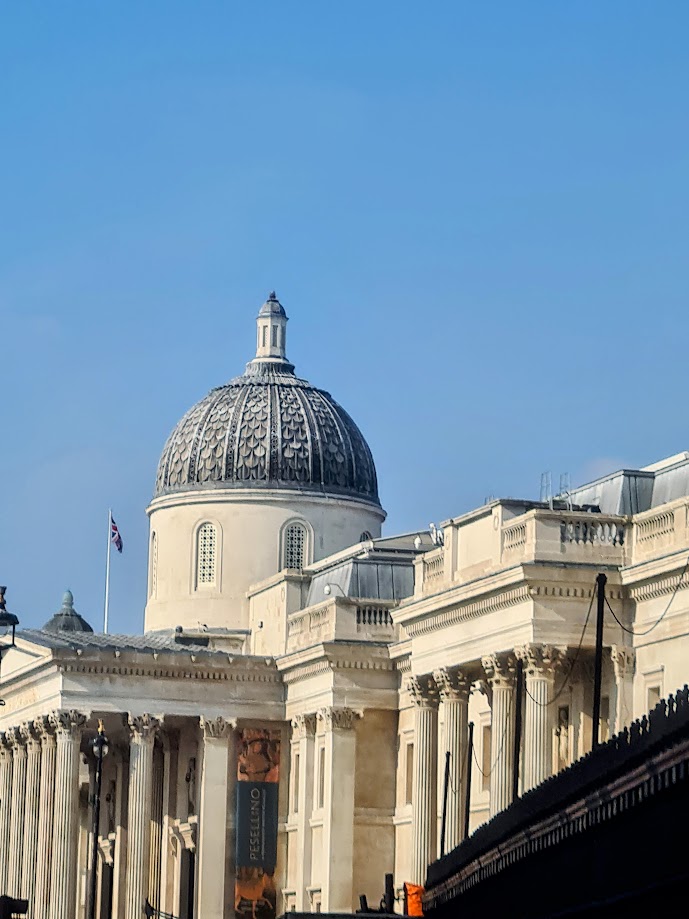
This is the visit where I realised that not all art galleries are created equal.
Another place that’s long been on my “I really ought to go and see that one day” list, my fondness for watching old episodes of Fake or Fortune on iPlayer pushed this one higher up in my priorities. It ended up being stop number one on a multi-venue expedition around the West End and surrounding area, but it was a good starting point.
I’ve spent longer writing this review than any of the others I’ve written so far (despite one of them causing a mild existential crisis) because I wanted to do it justice without glossing over some of the issues I had. Without further ado, let’s start as we always do with…
The basics:
The National Gallery sits at the top end of London’s Trafalgar Square (TfL Zone 1). It’s open daily and is free to visit, though you do need to book a timed ticket online.
The good…
The collection is vast. Truly, breathtakingly huge. There’s enough in there to keep someone busy for weeks if not months. The cast list of artists and works is astonishing – van Gogh, Cezanne, Rubens, Gainsborough, Constable, Michelangelo, Raphael – in fact, all but one of the Ninja Turtles were represented. And that’s only because Donatello was a sculptor, not a painter.
There’s also an awe-inspiring collection of Monet paintings. By awe-inspiring, I mean that it inspired me, upon entering the room that housed them, to utter the immortal words, “Oh fucking hell, it’s Monet”. Aloud. I was visiting on my own. Because I am a highly cultured person. Obviously.
I also saw a number of pieces that brought back almost-traumatic memories of school art lessons where we were, for some reason, tasked with recreating these renowned masterpieces (yes, Seurat’s Bathers at Asnières, I’m mainly looking at you). I was a bitter, bitter disappointment to those teachers, I’m sure. I’d say sorry, but really what did they expect from a class of mildly disinterested thirteen-year-olds? Anyway, Bathers was beautiful. It’s nice to see what it was meant to look like.
Truly, though, it was an almost out-of-body experience seeing these magnificent, world-famous works that close in front of me. I hadn’t realised how vast Water-Lilies was. Seeing the brush marks, the texture on the canvas and remembering who it was that made them, and how long ago, made me feel connected to them in a way I wasn’t expecting.
The bad…
This could be a controversial take given I was visiting an art gallery, but by the time I left, I rather felt like I’d seen…too much art? There’s something about seeing so much beauty in such a short space of time that dilutes its power and makes it feel less special. It was the point where I walked into a room, internally went “oh, more pictures of Venice”, rolled my eyes and walked on that I knew maybe it was time to cut my losses and visit somewhere else that day.
The rooms themselves are beautiful, and very ornate in their own right – almost too much so. Like trying to listen to three songs at once, the crimson walls and high, carved ceilings made it much harder to zone in on the paintings themselves and appreciate them in all their glory. I don’t know if this is an ADHD thing, or if it’s heightened for those of us with ADHD, but give me a nice, clean white space for my paintings any day of the week.
As someone who is both a history fiend and very lacking in art knowledge, I’d also love to have known more about the artists and the background to the paintings. The labels didn’t give me any of that, and left me doing a lot of wondering in amongst the wandering.
The only other gallery I can remember visiting was at the Lowry in Salford, and I think that set my expectations sky high (there’ll be a review of the Lowry – and specifically the permanent L. S. Lowry exhibition – when I finally manage to get back up there for another visit). Because that was dedicated to one artist, it told his story through his art, and I left having learnt a lot about his life and his process, as well as seeing his work evolve as time went on.
This isn’t a post about the Lowry, but it did highlight to me what I was missing at the National. I was left with the impression that this was a gallery for art lovers and those who were already knowledgeable, rather than a gateway into the world of art for the uninitiated (like me). And a subsequent visit to another large art gallery only served to highlight it more – so I’m sorry, the National Gallery, it’s not me, it’s you.
The Gallery’s website has a wealth of behind-the-scenes content, including a look at conservation work they’ve done on some of the collection. I’d have loved to see more of that alongside the paintings themselves – or even in a separate exhibition space. I want to learn things, not just look at pretty stuff!
I also found that the signposting around the galleries was nowhere near as clear as it could have been. This is likely partly because of the refurbishment work that’s happening around the building, meaning a lot of the paintings have been moved from their usual homes to remain on display, but it definitely isn’t the sole reason. In my attempts to locate the da Vinci, I found myself doing multiple loops of the same set of rooms, coming back in from a different direction every time and having to take a moment to find my bearings.
I didn’t find the da Vinci.
On my last visit to Trafalgar square before this one, I have a clear memory of sitting on the wall outside the gallery, waiting for a friend and watching everyone leaving with big smiles on their faces. At the time, I assumed it was because they’d had a great time, and of course it piqued my interest in visiting. On reflection, I wonder how many of them were beaming simply because they’d finally managed to locate the exit.
It only took me three circuits – which involved going both down and back up a flight of stairs – before I managed to find the door that led me back to the real world. There’s a crucial sign missing at an almost-hidden turning, and if you miss it, you’ll end up back where you started again. I was starting to think I’d never again see the light of day, and I’d have to move in to one of the galleries permanently.
The cafe was eye-wateringly expensive, even by London standards – I spotted bottles of juice for nearly £6, and the very small slices of cake were about the same. The coffee and chocolate & banana muffin I plumped for were fine, but not quite good enough to justify the hefty price tag. It was also hotter than the bowels of Hades in the coffee shop area – it wasn’t a particularly chilly day, so there really wasn’t a need for what seemed like industrial-strength heating, and it made for quite an uncomfortable pit-stop.
Things I didn’t get to see…
I honestly think I didn’t even scratch the surface on my visit. Had there been more information around, and better signage, I’d have happily spent longer. Because things had been moved around, I’m not certain just how much I missed, but I know I didn’t get to see any da Vinci. Which is a shame, because I was really excited to see if I could decipher all the secret codes that are absolutely, definitely hidden in the paintings.
So…is it worth the trip?
Despite my mixed feelings, it’s a big yes. It feels like a humongous privilege to be able to see so many incredible works of art in one place – and even more so when it’s free. There’s definite scope for improvement, but it’s definitely worth a visit.
At the time of posting this, it’s almost a month since my visit, and I’m getting a definite longing to go back for another visit. With the benefit of this visit to adjust my expectations, a map, and the guidebook I found at my local charity bookshop, I think I’ll get more out of it the second time. I’ll also plan to do it in smaller doses whenever I’m in the area, just doing one or two rooms at a time, so I don’t succumb to art fatigue again.
The small(ish) print: This is one in an occasional series of reviews of places I’ve visited under my own steam, with my own money. I’ve done my best to make sure everything’s accurate at the time of writing, and all the opinions are mine.
-
Cute exhibition review: Is it worth the trip?

If you’ve travelled anywhere in or around London in the last few months, you’ll likely have seen at least one advert for Cute, which has been open at Somerset House since the end of January. The AI-generated rainbow kitticorns have, honestly, been everywhere.
If you somehow managed to miss them, let me catch you up. Billed as a “…major new exhibition exploring the irresistible force of cuteness in contemporary culture”, Cute promises to unpick exactly what it is that makes us so drawn to, well, cute stuff.
There’s also a pop-up café, the Cute Coffee Shop which runs in conjunction with the exhibition, but doesn’t require a ticket to enter.
Ubiquitous rainbow kitticorns aside, as soon as I heard about it I really wanted to pay a visit. Growing up in the 90s and 00s, an age when (for perhaps the first time) it was cool to be into cute stuff even into your teens, I was interested to take a closer look at some of the nostalgia through the eyes of an adult. It’s only on for a couple more weeks, and so I jumped on my one last opportunity to catch it before the Easter holidays made it impossibly busy.
So…was it worth it?
The basics:
Cute is open Tuesdays-Sundays at Somerset House (Strand, TfL zone 1). Adult tickets are £18.50, and the exhibition runs until 14 April. The Cute Coffee Shop is also open Tuesdays-Sundays until 14 April.
The good…
There was a lot to see in a relatively small space and, thankfully, it was quiet when I visited so I was able to take my time on each exhibit. We start with a look at the origins of cuteness as we know it, first looking at Harry Pointer’s cartes-de-visite, and the delight of being introduced to the work of Louis Wain and his utterly charming cat cartoons.
As you’d expect from an exhibition sponsored by Sanrio, it’s heavy on the Hello Kitty. There’s the Hello Kitty Disco which as the name suggests, is a mirrorball-adorned room where you can have a shimmy alongside some Hello Kitty neon lights, if you so wish. The exterior walls of the disco room are adorned with a disconcerting number of Hello Kitty plushies, which I couldn’t help but think reminded me a bit of putting executed prisoners’ heads on spikes as a warning to others. What did you do, Kitty, what did you do?
There’s also a wide selection of Hello Kitty memorabilia on display; everything from the themed tins of spaghetti I remember from my childhood to spam kits, karaoke machines and a replica of the original coin purse that made the little girl (for that is what she is) famous.
Heading upstairs to continue the journey, the first thing that struck me was how carefully structured it all was for maximum Instagram-value. With sections framed by brightly-coloured archways (my favourite was, of course, the fuzzy purple monster) providing multiple photo opportunities, it’s clear that was always meant to be a big part of the appeal.
The central display was given over to various more modern examples of cuteness – well, I say more modern, but they’re mostly things I remember from my childhood, so I imagine they’d now be called “vintage”. There was everything from tamagotchi and Sylvanian Families to Animal Crossing, an IKEA Djungelskog bear and a Duolingo plushie, complete with examples of some of their more…unhinged social media content. In one of the alcoves opposite was a sculpture of a Techo, a delightful if unexpected throwback to the days when I’d book an hour in the library after school, to spend the entire time on Neopets.
Once those initial pangs of nostalgia had worn off, I was left with a distinctly uneasy feeling as I explored the rest of the exhibits. Partly it’s because the works themselves took a darker turn in the latter half of the exhibition, exploring the “monstrous other” and the way cuteness is used not just to camouflage unpleasantness, but also as a manipulation tool (it also looks at how it can be used as a tool of resistance in its own right) and partly because I’d simply…had enough cute for one day?
I found it really fascinating how rapidly I could go from “charmed, delighted and nostalgic” to “grumpy and horrified” – I barely managed to step into the Hannah Diamond exhibition before recoiling in dismay at the assault of twee-ness on all of my senses, and I’d barely been there half an hour by that stage.
Finally on the positives, the games arcade was a great addition; I could have spent a lot longer in there than I did, but I was keen to make sure I’d covered everything. It was lovely to see Calico included as one of the games on offer, and I was rather taken by Froggy Pot, a “…short cosy game with a small side of existential crisis” (honestly, same, Froggy Pot, same) which I will be downloading to play properly at home. I didn’t get to try out any of the other games, but there were plenty to choose from.
The bad…
This was such a complex exhibition, not just in terms of the subject matter but also the responses it elicited in me, that it’s really difficult to split things into simply “good” or “bad”. But this is the format I’ve chosen, so I’m going to stick with it.
Some of the labels made assertions that made me raise an eyebrow – I might be missing something (and please tell me if I am!) but I don’t know if I’d make the claim that the creation of Gorillaz was somehow “…anticipating today’s cutification of the self on the internet”.
I can’t think of a delicate way to phrase what I’m trying to say, so I’ll just come out with it: a lot of it felt a bit pretentious, and bordering on “trying too hard to sound clever and edgy” in a way that, frankly, really annoyed me.
There’s quite a distinct mismatch, too, between the tone of the advertising and the tone of the display itself; while we do get to look at a lot of cute things – especially at the beginning – the majority is given over to exploring the darker, more sinister and even macabre side of cuteness. I’ve mentioned already that it was really interesting to explore where cute spills over into something more malevolent (and my own reactions to it), and the more I reflect the more sure I am that this was part of the overall intention.
As the owner of what has been described as a “very expressive face”, I imagine that anyone who happened to spot me walking round the exhibits would think I was having a terrible time. I could feel my face scrunch up as I walked around some of the areas. Partly in bafflement, partly in distaste, partly just trying to make sense of what I was looking at.
The final work in the exhibition is DAZZLEDDARK, a five-minute “visual poem” of a film. It’s trippy, bizarre, kind of charming in an uneasy way and, ultimately, sums up the tone of the entire spectacle pretty well.
Once out of the exhibition – and via a quick browse of the gift shop – I made my way around to the coffee shop.
It turns out 11.30 on a Tuesday morning isn’t everyone’s favourite time for overpriced cartoon confections – despite having heard horror stories about the queues, when I popped round on the offchance it was fairly quiet, I was pleasantly surprised to be able to go straight in.
Wanting to get the full experience, I opted for the strawberries & cream Hello Kitty hot chocolate, at an eye-watering £5.95 (Yes, that’s five pounds and ninety-five pence for a cup of hot chocolate), which came with a long, long list of toppings and decoration. I wish I’d just ordered a cappuccino.
The “whipped cream” looked, felt and tasted more like shaving foam, and I’m not convinced it had ever been anywhere near a cow. Add marshmallows, sugar sprinkles, a rice-paper Hello Kitty disc and a truly repulsive “edible” bow made of something that vaguely had the texture of those fake white chocolate mice from bad pick n mix, and you’ve got the instagrammable-but-bordering-on-undrinkable cup of nightmare fuel I was presented with.
Once I’d got all the detritus out of the way, the strawberry-flavoured hot chocolate was quite tasty, but definitely not worth the price tag, even if I did get to keep the coaster (a cardboard, Hello Kitty equivalent of a beer mat). It was so sickly-sweet I felt queasy for a good few hours afterwards.
There’s a metaphor in there somewhere…
I didn’t order any food (I couldn’t justify spending any more money), and I’m not sad about it. The cakes on display looked very pretty, but if the drinks were anything to go by, I don’t know if they’d have lived up to the visual hype. It’s definitely the kind of place you’d visit for the vibes and the aesthetic, rather than the quality of the produce on offer.
Things I didn’t get to see…
Other than the fluffy lift (which I forgot about entirely until just now) I managed to get to see everything in just over an hour, as well as sampling the coffee shop. The only thing I didn’t do was anything more than stick my head into the Hello Kitty Disco – there was nobody else in there, and I wasn’t quite in the mood for a solo boogie at 11am. It was delightfully sparkly, though.
So…is it worth the trip?
I’ve gone back and forth on this a lot, because honestly, I’m…still not sure? It was interesting, it was thought-provoking, it was offputting, it was possibly overhyped. I felt profoundly uncomfortable at stages, and at others it was just the silly, cutesy fun I’d been primed to expect. And I think a lot of its brilliance is in that bait-and-switch, luring you in for one thing and delivering something else. I get the feeling that they put a lot of emphasis on making it instagram-worthy, and sadly that came at the expense of making it accessible to people who don’t already have a pretty deep knowledge of this kind of art and culture.
Having said that, it was a really interesting exploration for me personally, especially looking back at my reactions and how quickly I moved from being charmed to appalled.
As with the exhibition itself, my verdict is far more nuanced than a simple “yes” or “no”. On balance, though, I’d say it is worth the trip, if not all the hype that’s come with it. I’m glad I went, but I have no desire to see it again.
The café is a no from me, for sure – if you do still want to give it a try for the experience, or for the ‘gram, please do yourself a favour and don’t waste any time queuing for it. It really isn’t worth it.
The small(ish) print: This is one in an occasional series of reviews of places I’ve visited under my own steam, with my own money. Everything’s accurate at the time of writing, and all the opinions are mine.
-
I read a book: Daisy Jones and the Six

In my very first Love Letter (my very first post full stop, in fact) last summer, I talked about how I finally managed to rekindle my love of reading. Although it’s dropped off slightly again since then, I have managed to keep up a better pace. There’s been a lot of non-fiction – mostly research for a future rage-fuelled passion project/probable blog series at one point – but I’ve also made time to fit some fiction in as well.
I’ve been reading Naomi Alderman’s latest, The Future, since just before Christmas, but (and I’d expect nothing less from this author) it’s pretty heavy-going, especially with the current state of the world, so I’ve needed to take quite a few breaks as I go along.
It’s also a hardback, and so doesn’t fit easily into my bag. I needed something to keep me company on my adventures, so I reached for one of the many, many (many, many, many…) paperbacks on my TBR pile. Enter, Daisy Jones and the Six (Taylor Jenkins Reid, 2019). I’d had loads of recommendations for it, from loads of different people whose opinions I trust, so it seemed like a fairly safe bet.
The story…
Through a series of interview transcripts from people in and around the band, the book tells the stories of Daisy Jones, and a fledgling band which eventually becomes The Six. There are definite echoes of Fleetwood Mac as we follow the rise and fall of a rich, complex cast of characters. There’s sex, drugs and rock & roll in spades, but the real power is in the multi-layered relationships between them all. This is one of those tales that is better the less you know about it going in, so I’ll say no more, and move on to…
The verdict…
Daisy Jones was my first Taylor Jenkins Reid book, but it definitely won’t be my last. The transcript format took a little bit of getting used to, and definitely works better in physical print than ebook or audiobook, but it lends a real authenticity to the storytelling – especially in later chapters.
It was a beautiful, captivating gut-punch of a book – delivered in a soft, subtle way. I was also left with a sense of deep sadness that I will never be able to hear the songs that form the beating heart of the story. The lyrics to all of them are printed after the end of the story, which was a lovely touch – but I so desperately want to be able to hear the melodies, the instruments, everything that comes together to make the song – and the story – complete.
-
Subscribe
Subscribed
Already have a WordPress.com account? Log in now.
 Stephanie Franklin