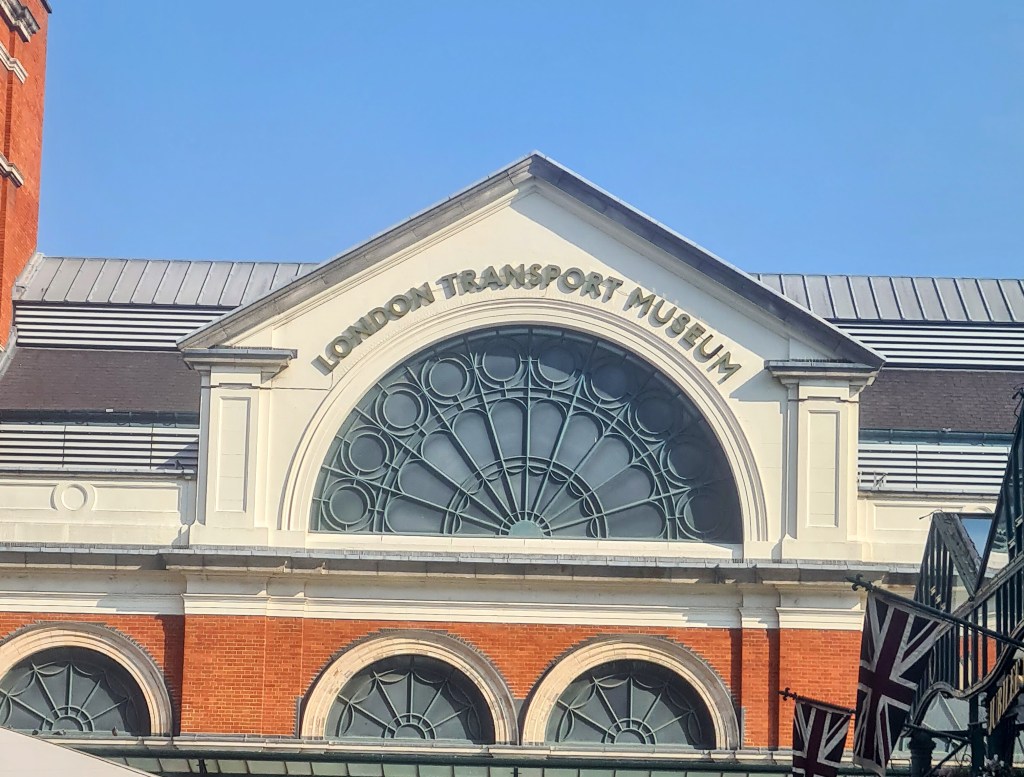
The London Transport Museum* has been on my bucket list for quite some time. Social and cultural history is probably my biggest area of interest when it comes to history – and there isn’t much else as intertwined with London’s social and cultural history as its transport system.
As a serial looker-upper when I’m out and about anywhere (with my apologies to anyone who has ever tried to travel with me on a tight schedule), the design and architecture of the tube has also fascinated me since I was a child. Add in a dollop of “Victorian things that aren’t the spinning jenny” and the promise of some rich World War 2 stories, you’ve basically got Steph’s Perfect Museum.
My visit was an unplanned addition to the touristy day I treated myself to a few weeks ago; I’d initially planned to focus on the free things to do, before I moved onto the visits I’d have to pay for. A series of fortunate events, however, changed my mind – and having tired of my first stop much earlier than I expected, and realising LTM was only a ten-minute walk away, I thought it was worth the ticket price.
Without spoiling the review before I’ve even started, I fear this little detour has sparked a new level of interest that is going to last quite some time.
*hereafter referred to as LTM, because I’m far too lazy to type it out in full every time.
The basics:
LTM is right in the middle of Covent Garden (TfL zone 1), and is open daily. Entry is £24 for an adult ticket, but that effectively acts as an annual pass and gets you unlimited access for a year.
The good…
The “feel” of the place was far nicer than any other London museum I’ve ever visited. The staff are absolutely wonderful, and I got the impression from everyone I came into contact with that they really enjoyed being there. It felt like a museum run by Museum People (in contrast to some of the bigger London sites, where the general feeling is – understandably – more of security and crowd control than history and/or subject enthusiasts).
There are tiny bits of attention to detail dotted throughout which are nothing short of delightful – from the presence of this miniature dog barking at the horses in a model of a 19th Century horse bus, to the moquette decals on the bathroom doors (I was tempted to take a snap, but didn’t want to get escorted off the premises for being weird, so I resisted).
And that’s before we really get into the exhibits. This post is already a lot longer than I’d planned, so take a deep breath because I’m about to give you a real whistle stop tour.
When I arrived, the lovely member of staff checking tickets recommended starting from the top, and working my way down. As you know from my IWM review, I’m a fan of a top-to-bottom route anyway, so that’s exactly what I did.
We start off in the 19th century with the “origin story” as the horse and cart, sedan chair and watermen on the river gradually give way to horse buses, trams and the railway. Along with the aforementioned excellent tiny dog, there are heaps of models, replicas and real artefacts from the time, along with some jumpscare-inducing life sized model people occupying various of the cabs and carriages. I got the distinct feeling I was being watched as I went around…
From there, we head down (both figuratively and literally) to look at the construction of the underground, how they solved the problem of where to put the steam, and tragedies that struck along the way, before London started expanding even more rapidly and we head into The growth of London. This floor is a real treat; there are replica trains and a huge array of posters, tickets and other memorabilia that really brings the story to life as the city blossomed into what we know today.
Next up is the Global Poster Gallery which, as the name suggests, is all about posters. It’s a fascinating look through over a century of posters, exploring how (and why) they were commissioned and designed, as well as comparing and contrasting some of the artwork with the final finished objects. It’s visually arresting, and feels like a real celebration of an iconic part of London’s history.
I learned SO MUCH I didn’t know before about the history of TfL and its predecessor, as well as the history of London as a city – and I was completely charmed while I was doing it. There were so many lovely touches throughout, including a series of labels highlighting the role of women – particularly in the early days when there were far fewer of them in the workplace, and especially in transport. It felt especially pertinent for a visit on International Women’s Day, but it’s nice to see that it’s part of the regular display rather than a token add-on.
One real stand-out among the exhibitions was Echoes of the Blitz, a photo gallery showing people sheltering in 1940s tube stations alongside people doing the same in modern-day Ukraine. The similarities between the sets of images were striking, and a poignant reminder that, for so many people, war isn’t a distant memory, or something we read about in history books. It’s a testament to people’s resilience in the face of truly horrific circumstances, and the fact that the everyday things – sleeping, eating, music, doing your hair – keep going. Echoes of the Blitz runs until Spring 2025, and I’d really recommend taking a look before it’s gone.
Did I mention that the whole museum was great? Along with the staff and the attention to detail in the exhibits, the route told a wonderfully coherent and engaging story, culminating in a celebration of the present and a look to the future. I left feeling surprisingly hopeful.
And finally…the gift shop. My energy levels were flagging by this point, so I didn’t spend long exploring, but there was an impressive range of stuff to buy, and what looked like a good range of price points. I’d say I was proud of myself for not buying anything (the tote bag doesn’t count, it was a practical necessity and I bought it before I arrived), but we all know that won’t happen again.
The bad…
There’s not a lot to say here (though the preschooler I spotted having a tantrum because there simply were not enough buses might beg to differ) – and, at least, nothing that truly counts as bad. There are a couple of areas where things could be improved slightly, so what follows are the result of me being very picky (who? me?). And, in fairness, there were quite a lot of buses, actually.
My main frustration is with what would probably have been my favourite exhibition, if I’d been able to see it properly. London by Design takes you through the story of how some of the most iconic London transport designs came to be. There are tiles, there’s moquette, there are tube maps, there’s plenty of Johnston typeface, and of course the roundel. It’s right up my street, it’s absolutely fascinating stuff, and there’s a huge volume of content packed into a very small space.
So why’s it ended up in the Bad Place? One word: Lighting. It’s housed in a boxed-off area on the ground floor, and the lighting levels in the whole “box” are really quite low. There are some cool light projections of posters running across the floor, but I’d swap them in a heartbeat for being able to see properly.
The cases are lit, but not super brightly, so it’s still tricky to see detail in some of the displays. Which, in an exhibition about design, where the visual details are absolutely the key, is a bit of a problem.
Because there’s so much packed into a small space, there are a lot of labels, and trying to match the label to the exhibit is a harder game than usual when you’re playing it in the twilight. I can’t be certain, but I assume the lighting levels are to help preserve the exhibits and stop them fading. But if you’re going to tease me with me tiles, light them properly so I can really appreciate the colours (and the Sherlock Holmes patterns)!
With my accessibility hat on, there’s a definite need for more seating, especially on the upper floors. The gallery spaces are quite narrow, and there’s so much packed into them that space is limited, but one or two seats at either end would be very welcome (and the design possibilities are endless: recreating some of those Victorian wooden seats? Spot-the-moquette? It would be GLORIOUS).
Because the museum is housed in a former Victorian flower market, and is all in one fairly open space, it does get quite noisy. It wasn’t all that busy when I was there (on a weekday afternoon in term-time), but the volume was still quite a lot to contend with. The Global Poster Gallery, as I’ve already mentioned, was an oasis of calm in the middle of everything with its slightly lower lighting and separation from the noise of the main space. It just needed a couple of seats…
Having said that, I do want to point out that it’s clear from both the museum itself, and the amount of information on their website, that there’s a big focus on accessibility – including running events for SEN families before and after hours, where everything is designed to be quieter. There’s also a video tour of the museum, as well as a visual story, and they have sensory bags available onsite. And actually, they’ve done a phenomenal job overall, given the limitations of the space. They’ve gone out of their way to make it as accessible as possible, and it’s definitely one of the more neurodivergent-friendly tourist spots I’ve visited in London.
One final thing, which is more of a wishlist item than a criticism: I’d love to have the option of a guided tour of the museum itself (there are tours of the Acton depot available, and the museum also runs the Hidden London programme, but I couldn’t find any options for tours of the main museum). There were so many questions I could have asked, about pretty much everything I saw, and having a guide there to flesh out the labels would have enriched everything even more. Though, given how many questions I’d have asked, it’s probably a mercy for the staff that they don’t offer tours. It’s entirely possible I’d still be there asking things now…
Things I didn’t get to see…
I managed to cover about ¾ of the museum in just under three hours. I’d slightly run out of steam (insert train joke here) by the end, so I missed a few bits on the ground floor: the Legacies: London Transport’s Caribbean Workforce, Time is Running Out and the On the Surface exhibits will have to wait for next time. I also didn’t spend enough time in Digging Deeper or The formation of London Transport to really do them justice. If you’re planning a day trip and want to cover the whole thing, I’d suggest you allow at least four hours, plus extra time for the gift shop and café, if those are your bag.
I also didn’t get a chance to visit the Canteen – but having looked at the menu since, I’m going to have to fix that next time I go.
So…is it worth the trip?
If you haven’t worked it out by now, yes. Very definitely yes. And a bit more yes. The few small frustrations absolutely weren’t enough to dampen my enjoyment – I had a great afternoon’s visit, and now I’ve been once and know what to expect, I’ll be prepared for the seating, and the noise levels. I’ll be going back fairly soon to cover off the last few exhibits I missed, so there might well be a mini part 2 in the coming months. And I’ve already got my eye on one of the Acton depot tours for later in the year…
The small(ish) print: This is one in an occasional series of reviews of places I’ve visited under my own steam, with my own money. I’ve done my best to make sure everything’s accurate at the time of writing, and all the opinions are mine.
 Stephanie Franklin
One response to “London Transport Museum review: Is it worth the trip?”
[…] longer reviews of the London Transport Museum, the National Gallery and Somerset House’s CUTE are already online, with more coming soon. And […]
LikeLike